AI Agents: How They Work, How to Build Them and How to Manage Them
AI is moving beyond answering questions to helping complete tasks. AI agents can interpret goals, use tools, gather information and adapt their actions based on results. For businesses, they offer opportunities to automate complex workflows, but their reliability depends on how they are designed, secured and managed.
What Are AI Agents?
AI agents are software systems that use artificial intelligence to pursue a goal by selecting actions, observing results and deciding what to do next within defined limits.
Unlike traditional automation, which follows predefined rules, an AI agent can adapt its next step when new information becomes available. For example, a customer support agent could check an order, review a return policy and prepare a suitable solution.
How Do AI Agents Work?
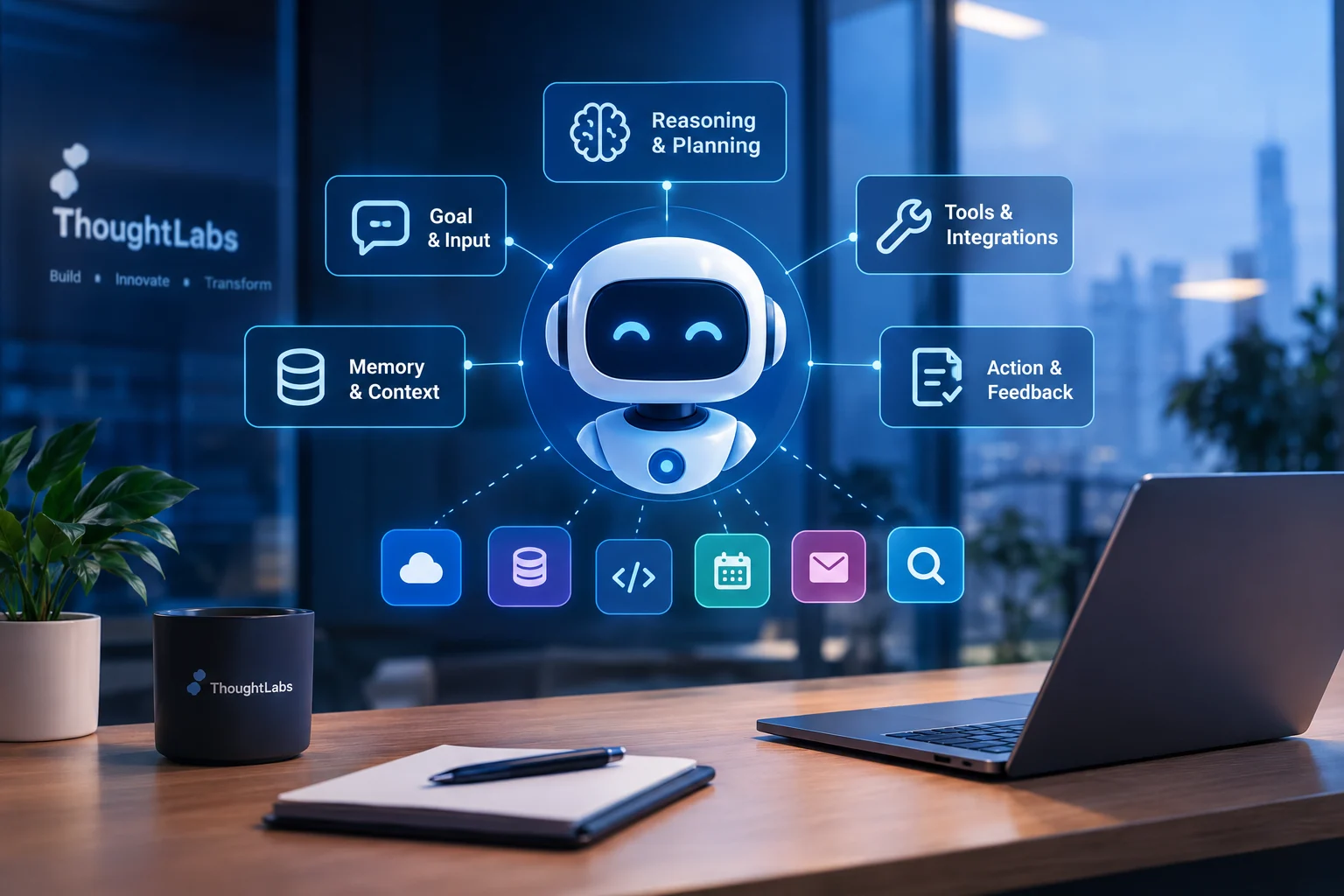
Most AI agents combine a few essential components:
Goal and input: Understand the user's request and identify the desired outcome.
Reasoning and planning: Decide which steps or actions may help achieve the goal.
Tools and integrations: Interact with APIs, databases and business applications.
Memory and context: Maintain relevant information and track progress.
Action and feedback: Evaluate results, adjust the approach or stop when the task is complete.
These components work together in a cycle. The agent chooses an action, receives a result and determines what to do next.
What Should You Consider When Developing AI Agents?
Building a useful agent requires more than connecting an AI model to an application.
1. Define a clear objective
Identify the business problem, expected outcomes and boundaries before choosing the technology.
2. Choose the right architecture
Start with the simplest approach that meets the requirements. A fixed workflow may be more reliable than an autonomous agent for predictable tasks.
3. Use reliable data and tools
Connect trusted data sources and design tools with clear inputs, outputs and responsibilities.
4. Prioritise security and privacy
Apply least-privilege permissions, protect credentials, restrict sensitive data access and validate actions independently of the AI model.
5. Test realistic scenarios
Test normal requests, missing information, incorrect outputs, failed integrations and malicious inputs before deployment.
6. Keep humans involved when necessary
Require approval for high-impact or sensitive actions. Provide clear escalation paths and a way to stop execution safely.
How Do You Manage AI Agents?
Management continues after deployment. To keep agents reliable:
Monitor performance: Track successful task completion, errors, response times and operating costs.
Review results: Check whether the agent achieves the intended outcome, not merely whether it generates an answer.
Control changes: Test updates to models, prompts, tools and workflows before release.
Handle failures: Set retry limits, timeouts and recovery procedures.
Maintain accountability: Assign ownership and regularly review permissions, logs and security controls.
Common Challenges
AI agents may generate incorrect information, select unsuitable actions, encounter integration failures or incur unexpected costs. More agents do not automatically mean better results.
Constrained permissions, reliable validation, continuous evaluation and appropriate human oversight help reduce these risks.
Conclusion
AI agents can help businesses handle tasks that require information gathering, decisions and interactions with multiple systems. Successful implementation starts with a clearly defined problem, reliable integrations, strong security and measurable results.
The goal is not to build the most autonomous agent, but to build one that delivers useful outcomes safely, reliably and cost-effectively.
Further Reading
Anthropic — Building Effective Agents: https://www.anthropic.com/engineering/building-effective-agents
OpenAI — Agents SDK: https://developers.openai.com/api/docs/guides/agents/sdk
OWASP — AI Agent Security Cheat Sheet: https://cheatsheetseries.owasp.org/cheatsheets/AI_Agent_Security_Cheat_Sheet.html
NIST — Generative AI Risk Management Profile: https://www.nist.gov/publications/artificial-intelligence-risk-management-framework-generative-artificial-intelligence